
This lesson was meant to be a review of sequences and an introduction to exponential functions, but would also be a good introduction to sequences and recursion in and of itself. I gave students 4 clues and asked them to answer the questions on the cards:

It took a while for students to make sense of the problem and in some classes I had to start them out with a problem statement: On what bounce are the balls closest in height? The other questions are important as well: On what bounce is one ball higher? On what bounce is the other ball higher? ...but sometimes too much at once is crippling.
My goal was for students to create multiple representations according to the LESH model:
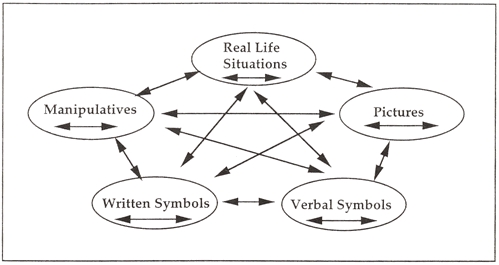
I tried to get them to draw a picture of what the scenario looked like but was met with a lot of resistance. It would have helped them to determine how many balls and how many people were involved and what questions they had to answer.
Here are some great examples of student work:


A great table, but I wish they would have defined what x and y represented.
Students who did not make an adequate enough graph said that the balls were the closest on bounce 4, but they are actually closer on bounce 15, reinforcing the need for thoroughness.
A good looking graph, complete with axis labels. Again, its easy to see that their are two spots where the balls could be the same height. Also, its easier to see which ball bounces higher during which bounce. Students who made an inadequate graph said that the Proportiaball bounces higher from 1-3 bounces but left out the second interval from 16 on. This is a good way to seque into domain as well.


Here is good student work showing the calculations, where its easy to see the ratio is always going to be (1.00-.10)

I caught several students who were going to go until the height of the Proportiaball was zero, when I asked them if they thought it was going to get to zero they said yeah, its going down, eventually it will be zero. This thinking leads right into algebraic limits and asymptotes. I brought this concept up to all of my classes and one student responded: "If I walk half the way to the lunchroom, then walk half the remaining distance, then walk half of that remaining distance, and so I won't ever mathematically reach the lunchroom, there will always be a small distance left."
To help with the idea that the Proportiaball never reached the ground I made this geogebra file and zoomed in and zoomed in to show them the function never touches the y-axis:
This student was able to write the recursive equations for each ball. In general, all of my students had a tough time coming up with the explicit exponential equation for this activity.

As a follow up to describing patterns and anticipating exponent rules I gave this homework out
describing exponential patterns HW


